Table Of Content
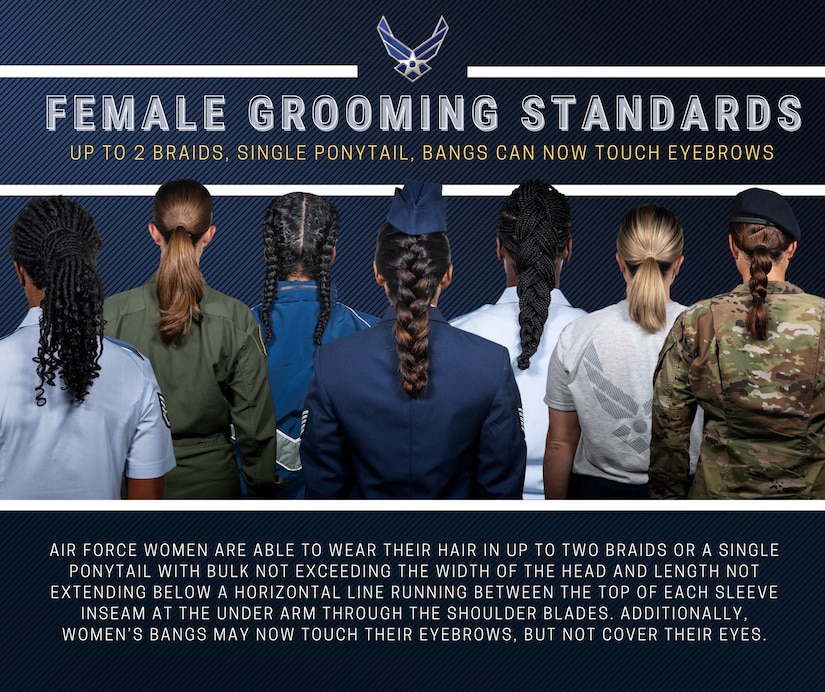
Hairstyles properly groomed shall not be greater than approximately 2 inches in bulk. Bulk is the distance that the mass of hair protrudes from the scalp. No individual hair will measure more than 4 inches in length.
Navy Grooming Standards: Hair, Beard, Mustache, and Nail Regulations
“There are just so many options available today for glasses and we needed to get some standardization of appearance in uniform,” Carroll said. Doleman added Sailors must be informed of all uniform and hair regulations to display a disciplined appearance, and to always remember what the uniform represents. Prescription glasses and sunglasses frames worn in uniform must now conform to new rules. The Naval Service Training Command enforces stringent certification requirements on all personnel applying to the NJROTC program. School officials may not offer employment to an applicant who does not possess a valid NSTC certification. Navy Region Legal Service Offices (RLSOs) provide legal assistance to eligible personnel and family members around the world to promote readiness and to enhance morale and quality of life.
Program Information
Longer hair like braids or cornrows must be neatly fastened, pinned, or secured to the head, and bangs cannot extend below the eyebrows. The Navy considers sideburns a part of the haircut and requires that they are neatly trimmed and tailored. The hairstyle must also not interfere with military-assigned headgear. Naval members are not allowed to color their hair differently from a “natural look”.
Region Legal Service Offices
Colored nail polish is not authorized for men.b. Fingernails shall not exceed 1/4 inch measured from the fingertip. The tips of the nails may be round, almond/oval, or square in shape. Nail polish may be worn, but colors shall be conservative. White, black, red, yellow, orange, green, purple, blue, hot pink, grey, glitter, striped, or any sort of pattern/decorative nail polish are examples of unauthorized nail polish colors.
False eyelashes or eyelash extensions are authorized that project a natural appearance and are no longer than 14 millimeters in length as measured from the eyelid to the tip of the eyelash. False eyelash color will match the color of the natural eyelash. Eyelash extensions cannot hinder wear of protective eyewear.
The Navy is clarifying its grooming and hairstyle standards to fight the appearance of racial bias - Task & Purpose
The Navy is clarifying its grooming and hairstyle standards to fight the appearance of racial bias.
Posted: Wed, 03 Feb 2021 08:00:00 GMT [source]
Other Grooming Standards
Frame colors can only be silver, gray, black, navy blue, brown or gold. They can, however, be transparent or translucent. Sunglasses can also be green and sport small logos.
Additionally, ponytails will not extend outward more than three inches behind the head as measured from the securing accessory, nor shall the width exceed the width of the back of the head or be visible from the front. In spaces or environments where there are operational hazards such as rotating gear, etc., the hair may not be worn below the bottom of the collar. Therefore, hair/grooming/personal appearance while in uniform shall present a neat, professional military appearance. Commanding officers will ensure facial hair does not impede the ability to safely wear and properly utilize emergency equipment when required. The NJROTC program was established by Public Law in 1964 which may be found in Title 10, U.S.
No portion of the bulk of the hair as measured from the scalp shall exceed approximately 2 inches. Hair shall not fall below a horizontal line level with the lower edge of the back of the collar as indicated by line A. When wearing Jumper uniforms, hair can extend a maximum of 1-1/2 inches below the top of the Jumper collar.4.
Hairstyles will not interfere with the proper wearing of headgear, protective masks or equipment. When headgear is worn, hair shall not show from under the front of the headgear. Hair is not to protrude from the opening in the back of the ball cap, except when wearing a bun hairstyle. All buns shall be positioned on the back of the head to ensure the proper wearing of all headgear.
You need to meet certain grooming requirements, with hair length being one of them. All of this is discussed in meticulous detail in the article above. Consequently, no articles other than earrings for women are authorized while on duty. When the bun is considered, bulk may not exceed 3 inches when measured from the scalp and the diameter of the bun shall not exceed the width of the back of the head. The length of hair, when in uniform, may touch yet not fall below a horizontal line level to the lower edge of the back of the collar.
Navy grooming standards apply to a number of other parts of the human anatomy. These include body piercings of any type, like nose or lip rings. Strands that are dyed with unnatural colors are not authorized.
The length of the mustache “fully extended” cannot exceed approximately 1/2 inch. It is also not allowed to go beyond a horizontal line that extends across the corners of the mouth. Mustaches are allowed by the Navy, yet must be kept neat and closely trimmed. The Navy defines “bulk” as the distance that the “mass of the hair protrudes from the scalp”. “TF1N did not drive the policy changes, but it can be noted that some of the changes align with the Navy’s Diversity, Equity and Inclusion initiatives,” he added.

Bracelets will not present a safety or FOD hazard. A ponytail is a hairstyle in which the hair on the head is pulled away from the face, gathered and secured at the back of the head with an approved accessory. Hair extending beyond the securing accessory may be braided or allowed to extend naturally. The wear of a single braid, French braid, or a single ponytail in Service, Working, and PT uniforms is authorized. The following criteria pertain to the wearing of ponytail hairstyles while wearing a U.S.
Locks may not be worn in combination with other hair styles (e.g. twists, braids).(3) Locks that do not meet the above standards and do not present a neat and professional military appearance will not be worn in uniform. Commanding officers have the ultimate responsibility for determining when hairstyles are out of standards. Haircuts and styles shall present a balanced appearance. Lopsided and extremely asymmetrical styles are not authorized. Pigtails, widely spaced individual hanging locks, and braids which protrude from the head are not authorized.
Hair coloring, wigs, or hair pieces must be of a natural hair color, such as blond, brunette, brown, red, gray, or black, not be distracting from a professional appearance in uniform and complement the individual. Hair extensions must match the current color of the hair. Tints and highlights shall result in natural hair colors and be similar to the base color of the hair. When hair accessories are worn, they must be consistent with the hair color. A maximum of two small barrettes, similar to hair color, may be used to secure the hair to the head. Bun accessories (used to form the bun), are authorized if completely concealed.


No comments:
Post a Comment